Everyone’s favorite topic is traffic management. This is an undeniable fact, and if you say it’s not your favorite thing, let’s be honest: it’s because you’re defective. I’m sorry, that’s just how it is. It’s such an exciting subject that they only way I could think of to immediately grab your attention with it was to attack you directly, making this a personal assault on you, and now you have to follow the whole rest of the article to see if I say anything else mean about you, or if I leave myself open to a counterattack of some sort. Just so you know, I won’t, this article will be immaculate, and you’ll just have to go along with the whole thing to prove otherwise. Because you’re an idiot! Keep going with me, don’t go away!
The reason I’m writing this article is because recently, we held a City Skylines competition on our Discord server, and the rules were, “Do whatever you want that you think is interesting, then we vote on who was the most interesting, but you also have to reach a population of 70,000 and share your traffic numbers.”
Early on, there was a good amount of excitement! Which then dropped off over time. A month later, we received one submission, which was merely a statement of what could have been if that person’s city hadn’t been whacked by multiple tsunamis. Which, in fairness, doesn’t say anything about that person’s traffic management skills. In fact, their traffic was pretty good after everyone had drowned, because there was no one on the roads. Wiping the slate clean with the blood of the innocents does, in fact, solve all traffic issues. It solves a lot of population-related problems, at that, but it had the drawback of preventing the target goal of 70k citizens.
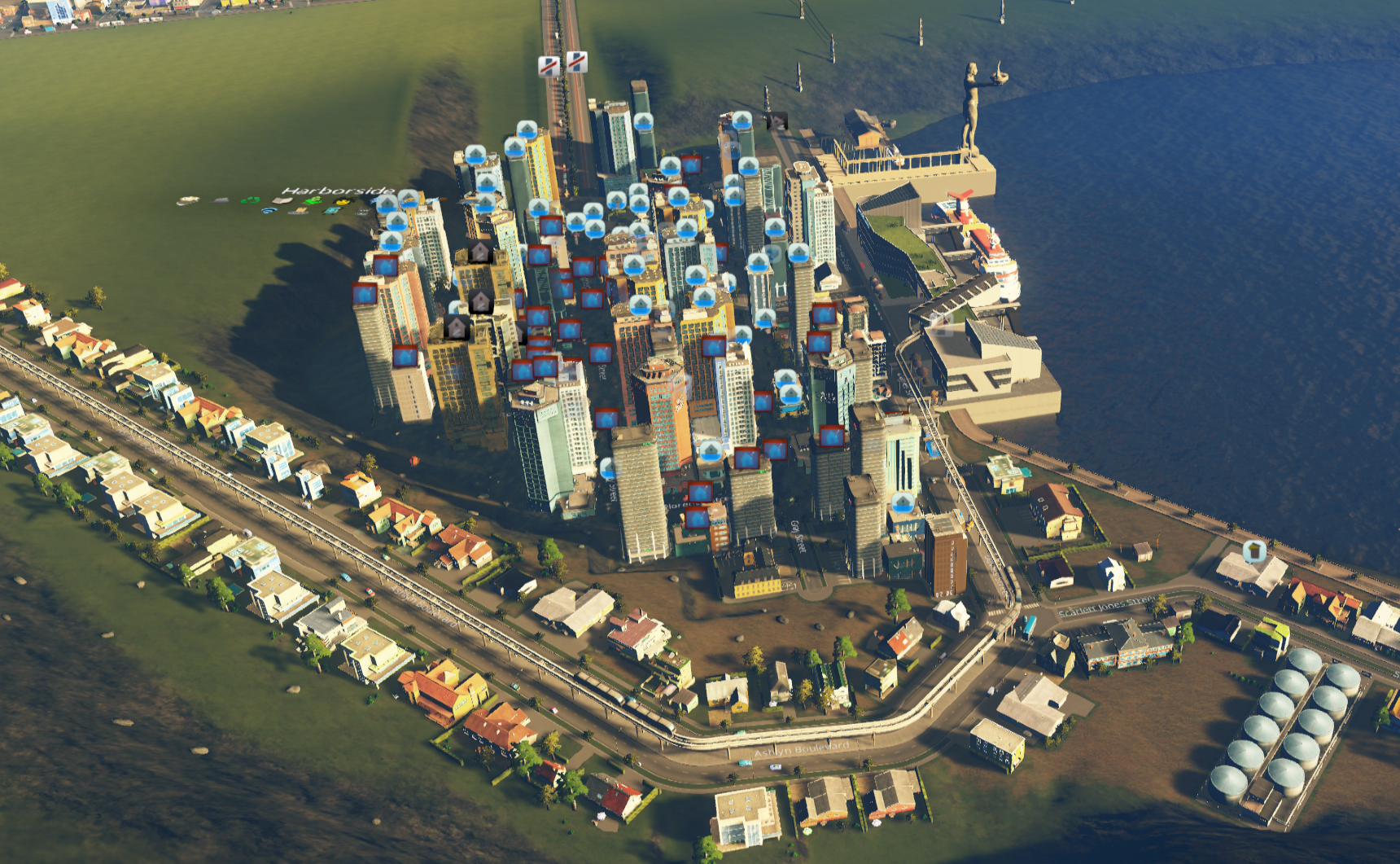
It does look like it was going to be cool. Before Poseidon developed a personal grudge with it.
I enjoy strategy games and management games. The main thing they have in common is that, frankly, they’re all won pretty much before you started. There’s an old saying: “Know your enemy, know yourself, never know defeat,” and effectively it just means that if you know what you’re doing and prepare adequately, you really can’t lose. Whether it’s Stellaris, Supreme Commander, City Skylines, or Transport Tycoon, it holds true as a consistent fact.
For my part, my city goal was simply “MAKE BIG CITY” because I often hear that City Skylines is fairly difficult without traffic management mods. Now I’ll grant you, traffic mods make the game easier because almost the entire game is about managing traffic, but I assure you it’s not necessary.
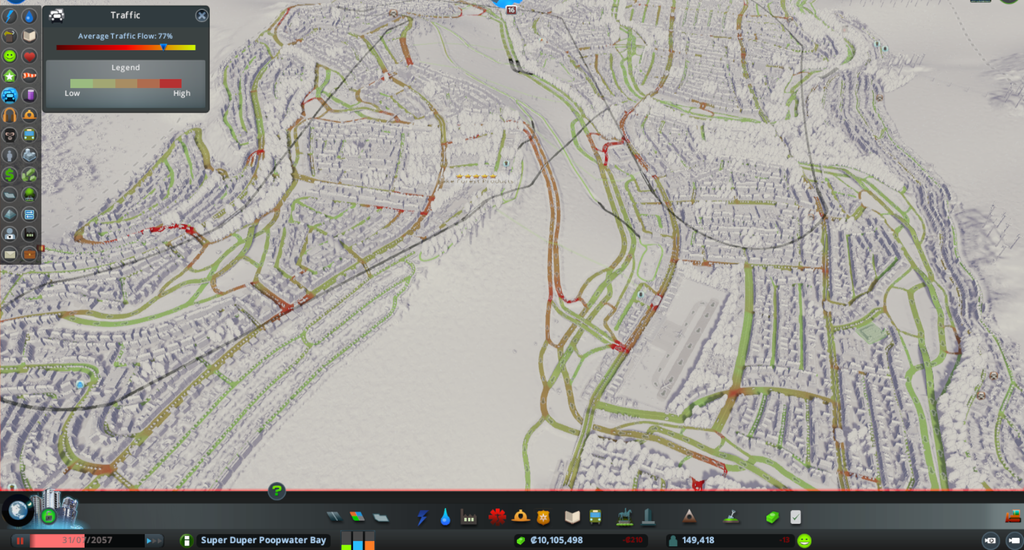
Initially my thought was that I’d fill up as much map space as I could, and based on the way people were talking, if anyone had a city as large as mine, I could insist mine was still better because it was built using nothing but the game’s unmodded traffic systems. My city is BIG, and your city is dumb, and whatever happened, these things would be true. I don’t know if that gets you a vote as “best” or “most interesting” city, but I think it was also clear to everyone that it was meant to be a fun, creative challenge and nothing serious. As I began to see people talking about having major issues, however, I began to realize that many competitors weren’t even going to make it to 70k population, and me having twice that was totally overkill.
So how’s it done? Well, Skylines is a traffic simulator, so the fun thing about it is that it models real-life traffic behaviors and that’s kind of the long and short of it. If you guys care enough to research that stuff, than you’ll have no problem reaching 70k population, and the game becomes more about whatever weird objectives you set for yourself aside. In this case, it was about absolutely ruining the bays with human waste, and growing to a massive size.
Traffic problems exist before they appear. Basically, if you design your roads badly, they’ll seem fine at first. When the only person on the road is grandma taking her twenty cats down to the taxidermy store to preserve the latest casualties, it honestly doesn’t matter how you built your roads. Grandma alone isn’t enough to cause any backups or gridlock, because she’s only one woman. However, when the city is populated by hundreds of grandmas, eventually they all die and then you need just as many hearses driving to every neighborhood, and soon you have a massive parade of hearses trying to reach these old women before their cats eat the body.
At the simplest level, you can avoid this by arranging your roads into arteries and capillaries. That is, big roads feed into small roads.
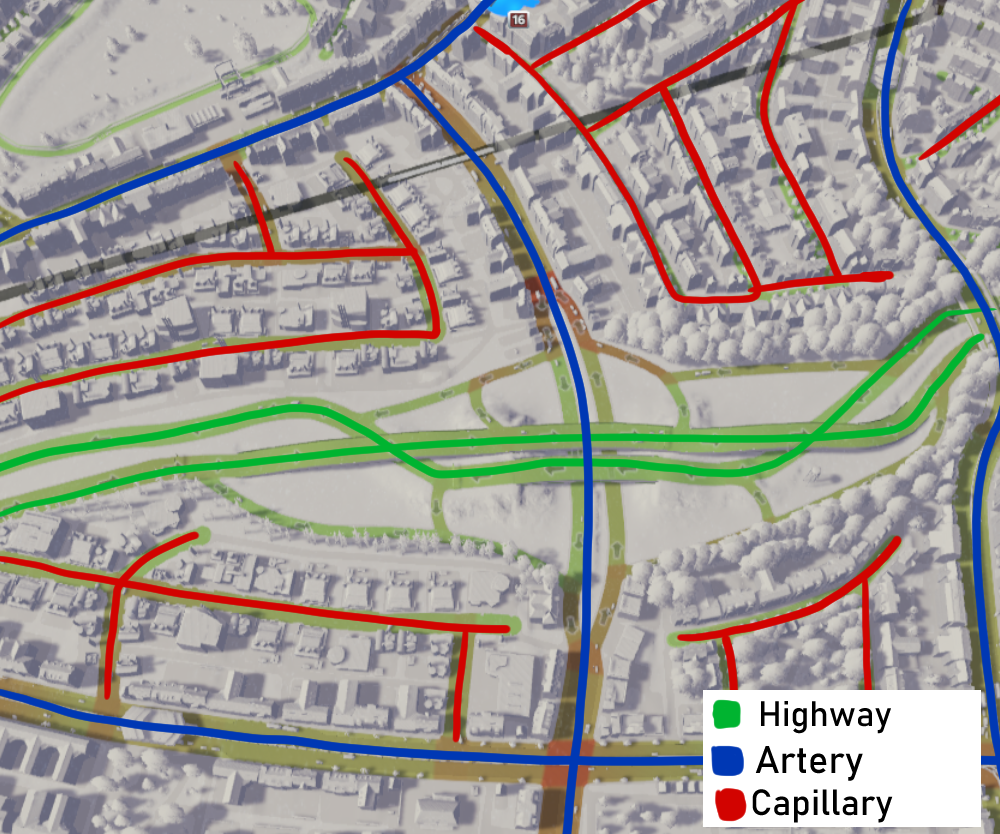
In this example, the highway feeds into a main road, and those main roads can reach anywhere in the city. Those main roads are the city’s “arterial” roads and are where all of your traffic is forced to travel. See, you plan out the arterial roads so that you know all the traffic has to either be there, or on the highway. The capillary roads then branch off from the arterial roads, but don’t connect to anywhere else. You see how they’re just sort of isolated pockets. Having them isolated like that prevents there from being any through-traffic on your smaller roads, because you can’t get to anywhere else through the capillaries. That means traffic will always be flowing along the arteries to whichever capillary it needs to be at, and if you’ve done this much, then you’ve eliminated most of the traffic issues that will snag new players.
Now those with a keen eye might notice there’s something funny about my highway! It’s what’s called a diverging diamond, but actually this one is especially odd because it’s a “fantasy diamond”. That is, in real life, bridges are expensive as all hell. If there’s one thing a city or a state does not want to do, it’s building more bridges than are necessary. You can make arguments about future traffic flow until someone at the city council pulls a gun on you, but in real life a bridge will cost a fortune up front, and then you gotta maintain that bitch.
However, video games know that transit enthusiasts like bridges in the same way that sci-fi enthusiasts like it when spaceships explode into glorious fireballs. It doesn’t matter how realistic it is, or if there’s any oxygen in space to create the exciting fireball that spaceship bursts into. Fans of these genres just don’t have as good of a time unless you cater to the spectacle. City builder nerds want to build bridges, which means game developers don’t make them into a once every ten years project, and their maintenance won’t bankrupt you. As a result, you can make some truly fantastical highway interchanges.
The “fantasy diamond” is something I’m proud of, partly because I arrived at its genius, innovative design on my own out of necessity, and partly because I’m some kind of disgusting nerd, and fantasy worlds with these sorts of inane efficiency tests make me happy. A fictional traffic backup makes me actually, genuinely mad, and these things are almost supernaturally effective at making those highway backups non-existent. But what’s funny is that I didn’t start building these things in City Skylines. Rather, I developed them while playing competitive Transport Tycoon.
Oh, yes, in my personal hours of entertainment, I get up to hobbies so nerdy that polite society probably shouldn’t condone them. You can argue it’s harmless, but I don’t know if anyone has done any real studies on the psychological impact of hyper-optimizing transit games. It’s just too nerdy of a subject to examine, even for paid psychologists.
But here’s kind of what I was dealing with:
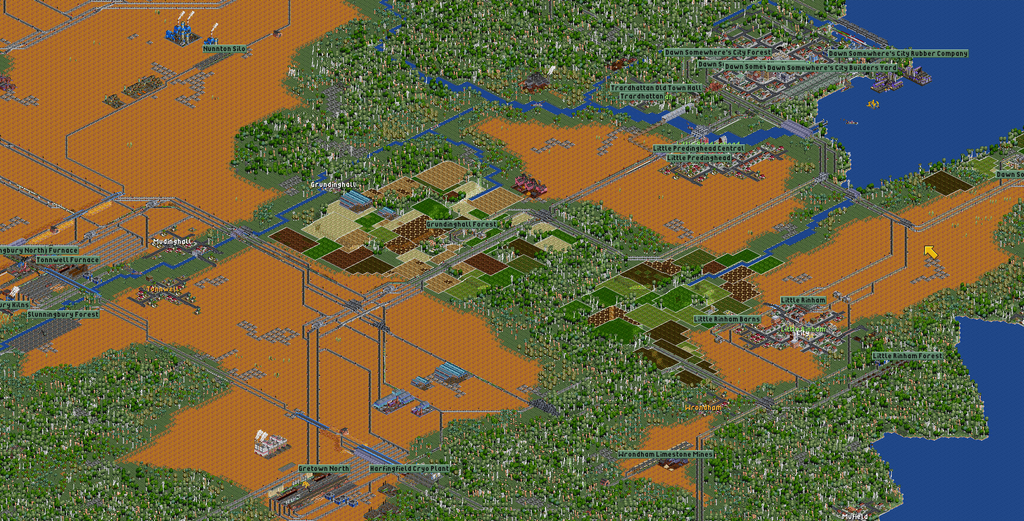
In competitive Transport Tycoon – which is a delightful game as much as I joke – your goal is to grow a single city to some forsaken size, and you do this by delivering larger and larger amounts of cargo to it. The city wants a broad variety of different cargoes, and each form of cargo may need to be produced by delivering yet another form of unique cargo to some factory somewhere. If the game setup only demands a few types of cargo, you can be safe to set up a specific line for each kind of cargo, and that’s pretty manageable. You can get one for water, one for food, one for passengers, and it works out because even though the various cargo tankers travel at different speeds, each form of cargo is on their own line and they all travel at the same limit.
But that’s for babies. In the Dawn Somewhere server, we play transit management games for men.
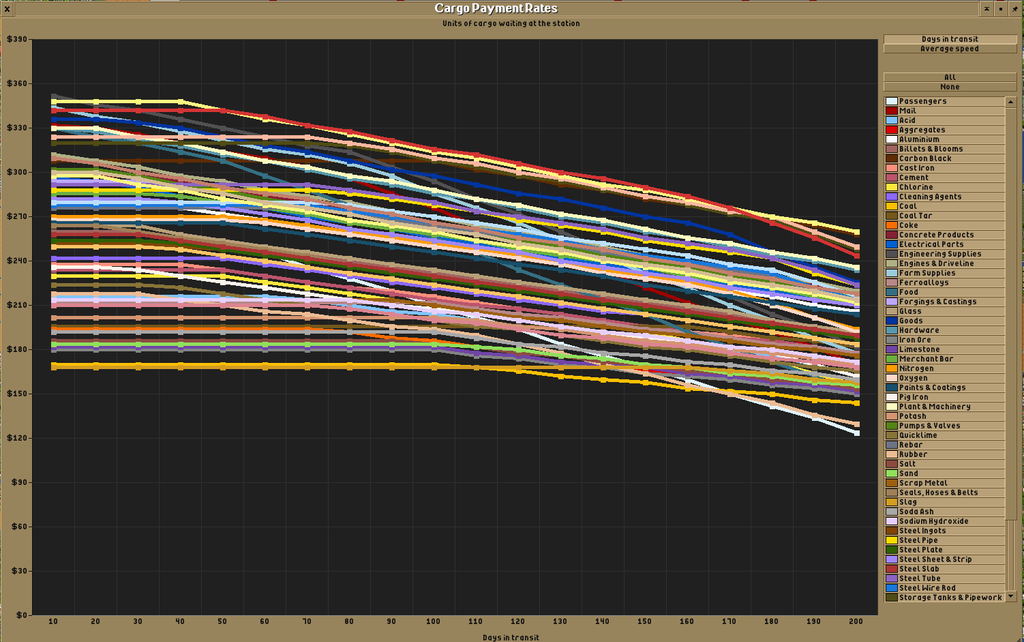
I can’t even show you all the cargo types we’re dealing with! And you’ve got to move this stuff back and forth all over the map, gradually building up massive infrastructure networks. These weren’t games where you play for an hour and find a winner. We’d play over the span of several days and really separate the carefree children from the adults who we should probably be concerned about.
And the problem was – other than whatever sick psychology makes me think this is a great leisure activity – the problem was: trains are frickin’ long, man! Like, damn. If it’s long enough to carry all this trash across the game map, the last thing you’d want to do is set up a railroad junction where another train has to wait on all that.
If you check out what the other deranged lunatics online are saying about how to handle this problem, there’s a number of different approaches. One of which is modifying the game to set up more complex signaling, which incidentally is also what I see people saying about traffic management in City Skylines. It’s also one of the ways that we handle this in real life, to be fair, and most states have a traffic light department whose sole job it is to optimize traffic signals. Or they try to, anyway, with variable success. But I thought there’s got to be a better way, there’s got to be a means to make junctions that just don’t suck.
This is where the “fantasy diamond” was born. I needed those trains to merge without almost ever stopping, and there was a way!
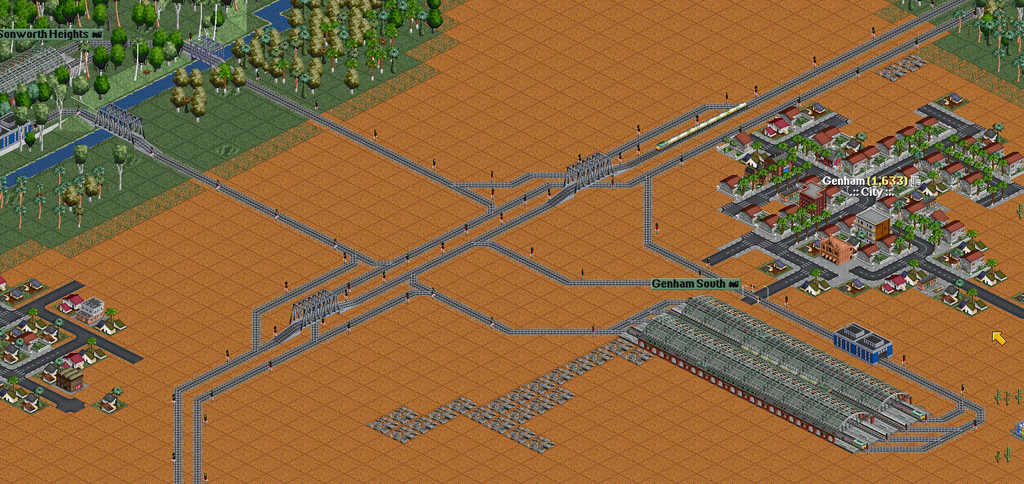
Pictured is one of the less complicated examples of how to build one of these, and it’s still a little complicated if you don’t know what you’re looking at, but don’t worry because I will simplify it. At an overview, a “diverging diamond” is called that because the traffic lanes cross over each other and form a diamond shape in the process. That means that eastbound and westbound traffic switch places, for example. If you normally drive on the right side of the road, you wind up driving on the left side for a bit, and you can choose to head north or south while you’re on the “wrong” side of the road.
The problem with the trains, though, is that normally when these are roadways for cars, they’re managed by traffic lights. It was possible to also manage a railroad junction with signals, but once hundreds of trains were competing to move down the tracks, if any one train was parked at a light waiting for a train to pass, that meant hundreds of other trains were also going to wind up behind schedule due to the waiting. It’s fine for road traffic, because cars are short, but completely bonkers for trains. Or… it was, except you may notice the two bridges on either side of the junction.
The solution was to use our fancifully cheap bridges to make it so that traffic never has to intersect! And this design completely revolutionized competitive Transport Tycoon for me, because now I have all these trains operating on a single line, without hardly any slowdown at any junction, and the only thing I have to do to incorporate more supplies into my network is simply branch off of the main artery with more “fantasy diamonds”. It works not only as a four-way intersection, but can also be used for equally efficient T-junctions!
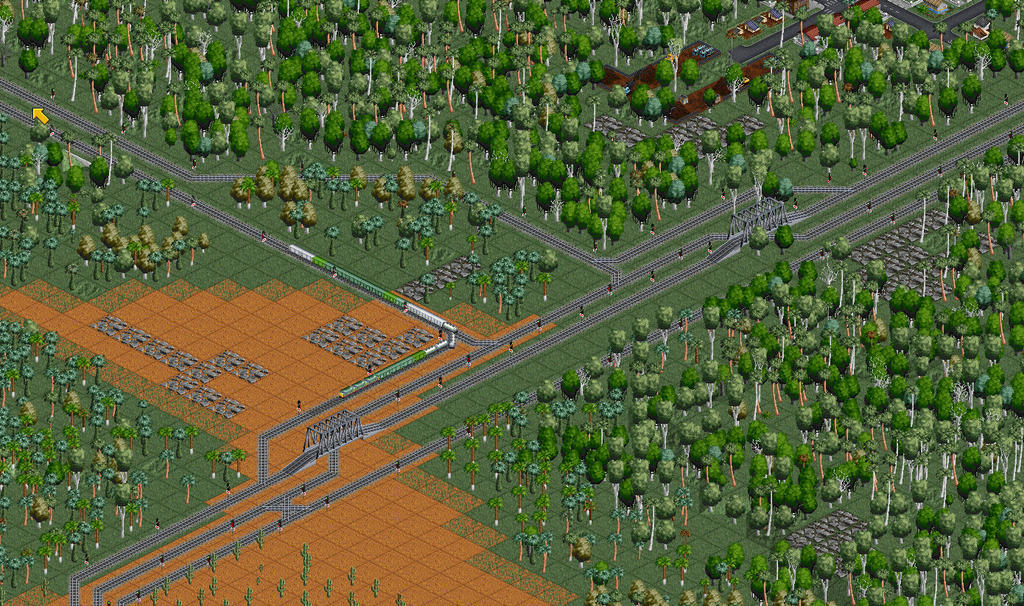
Yes, that’s right! Behold! A T-junction with the incredible traffic-flow potential of the “fantasy diamond”, and most glorious of all, it’s simply waiting for me to add a southbound junction if I ever feel the need for one. Do trains wind up needing to go north and south? Well I’ll just build a bridge joining the two pathways and we’re in business! These things were amazing, because they made the whole process of building the rail networks feel modular and easy.
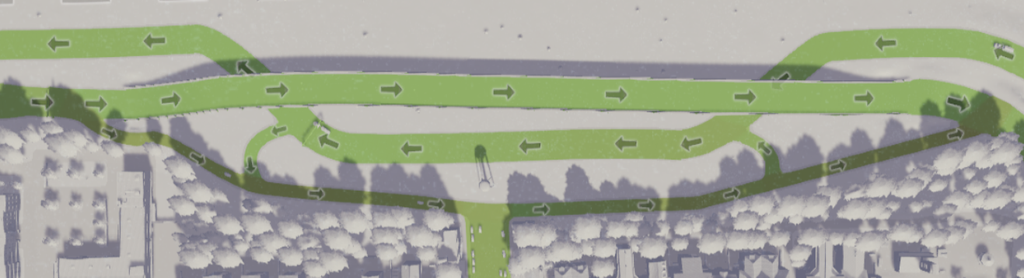
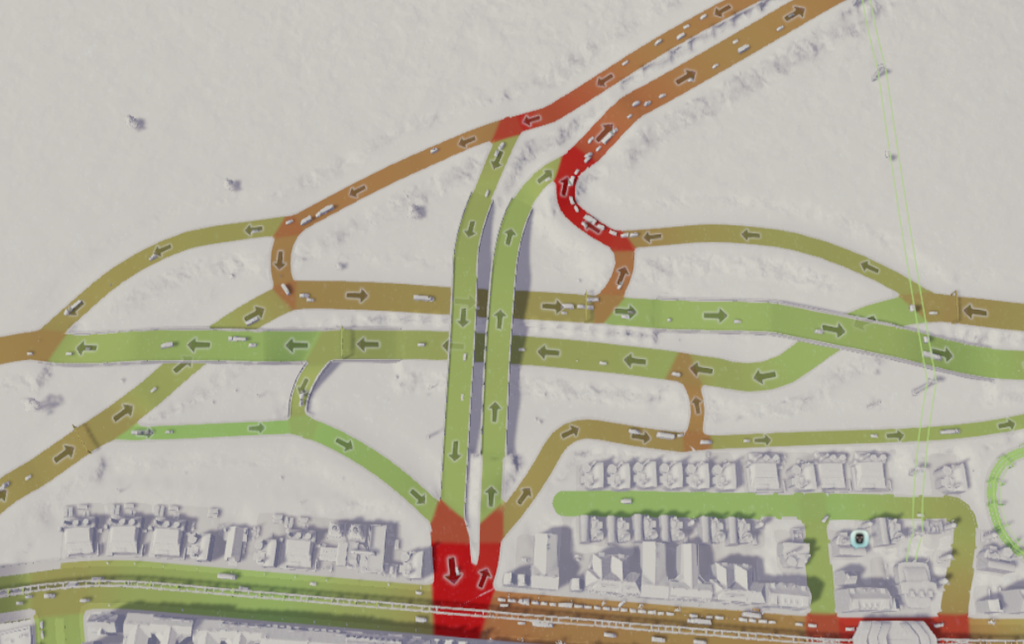
This is simpler to visualize in City Skylines, thanks to the arrows showing you the direction of the traffic flow. Here’s a “fantasy diamond” T-junction that I built on the edge of my city. I wasn’t sure if I was going to buy land on the other side of this highway, so I figured I’d do the same thing I do in Transport Tycoon and set up the highway like this, with the potential to expand if necessary.
This is actually a bit defiant of how they do a diverging diamond in real life. Normally, because they have to have a crossing managed by traffic lights, the crossings occur on the arterial road, not on the highway, but because I’m using bridges to simply leap over the lane people are merging onto, it works just as well to have the highway itself be where the crossings are. This is also incredibly efficient for space – I mean look at this. The default T-junction is a great, big monster with bridges looping all around, struggling to find space to hook into the highway. This is so much better.
In truth, this road is practically empty, and I’ve wisely built a water tower directly in the way of the road so that I can’t actually expand that way if I wanted to, so this optimization is totally unnecessary and made worse by my own lack of foresight. But installed properly there’d be all kinds of potential to expand out, and the road could handle even dense, industrial traffic!
So there’s a lot of tricks to make City Skylines and its traffic management a little easier. For example, it turns out that you don’t need to build commercial zones, because nobody actually needs to go shopping. You can build nothing but offices, and I suppose the people forage for live rats for dinner each night. That’s a kind of technocratic future that’s possible if you understand the deep weirdness of the game and ignore it begging you to play in any other way. With the right know-how, you can eliminate traffic via magic and cruelty.
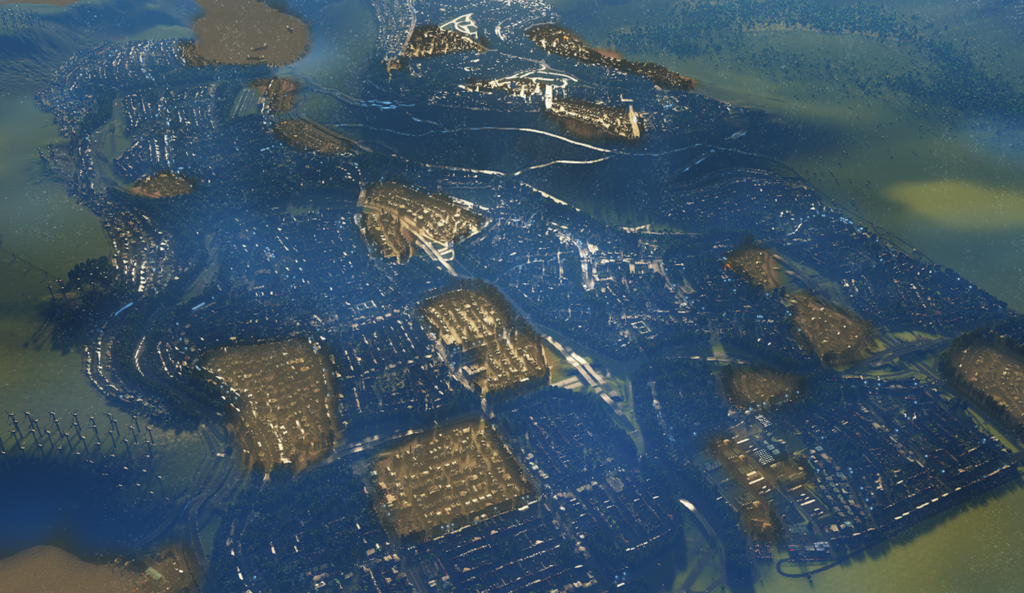
But that’s not what the city of Super-Duper Poopwater Bay is about. The city doesn’t use any mods. I’ve got commercial buildings placed near enough to the residential buildings, and then have horrible, pollution-ridden industrial districts providing goods to the nearby commercial buildings. I’ve got trucks and traffic on the roads, and all the buildings that cause those traffic problems, but between building the city with arterials and capillaries, and the use of “fantasy diamonds”, there’s room to expand even further than the 140k population the city already has. The waterways won’t appreciate it, and it’s a miracle the dockworkers don’t perish from the stench alone, but nobody said that the perfect intersection made the entire city perfect, now did we?