Some years ago, I put together an essay on how to write OCs for fanfiction. It felt relevant at the time because back in the day, it was a lot more common to see text-based creativity on the internet. Now, we see that everything revolves around whatever the tech monopolies have bought, which is to say it all revolves around Youtube. In fact, Facebook managed to kill numerous companies that originally thrived on articles by tricking them into thinking that video got way more viewership than it ever truly did – which convinced those companies to transfer to a more expensive format they couldn’t sustain – and I don’t believe there was ever any adequate comeuppance for that crime, but we’re getting away from the main topic.
Today, what we wind up seeing is the occasional major project that comes up and has enough money or fortune thrown into it that it breaks through the surface of corporate monopoly and then wows us with honestly just an incredible amount of mediocrity. I’ve written about “The Amazing Digital Circus” before, but it’s a fine example of this – it’s a show that generated tons of hype, and millions of views, and if it were designed by one individual just to post on Newgrounds fifteen years ago, it would legitimately be amazing. However, the amazing thing about it would be the animation quality. The writing leaves a lot to be desired.
What kills me is that when Amazing Digital Circus was blowing up, people were talking about it being proof that the markets are doing great and independent animation is on track to succeed. But then what we got was something like… I don’t know, “Bump in the Night”.
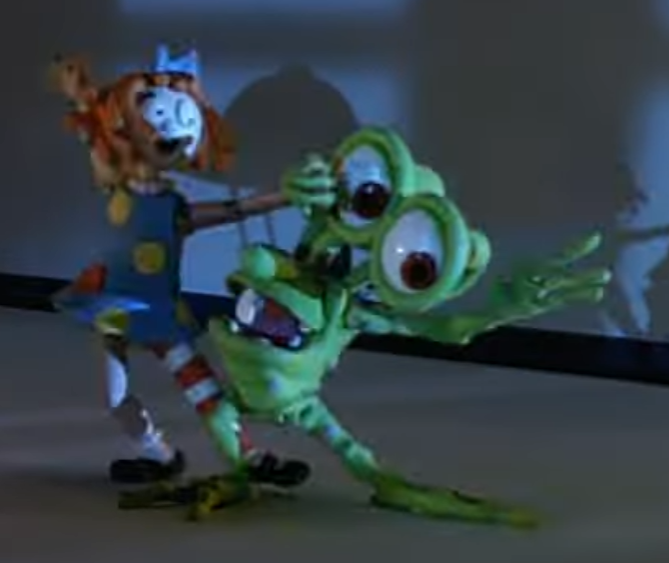
Now if you grew up in the era where you might have seen “Bump in the Night” on TV – and I’m getting older every day so I know fewer and fewer people will have heard of this show – then you might vividly remember Mr. Bumpy but not remember a single goddamn thing that ever happened in the show. That’s not to say it was a bad show, or that I disliked it. Mr Bumpy had a ton of visual character. His best friend was a blue guy who lived inside the toilet.

I mean, this is just such a neat set. We’ve got this blue lighting in the pool, his home has a “porcelain palace” vibe going on. I DON’T REMEMBER THIS CHARACTER’S NAME. He was just some whiny blue person. I don’t even know what he was supposed to be. Some kind of monster? The potty boggie? Like I get Mr. Bumpy, he’s the monster under the bed, but I don’t know what mythological thing this blue dude represents.
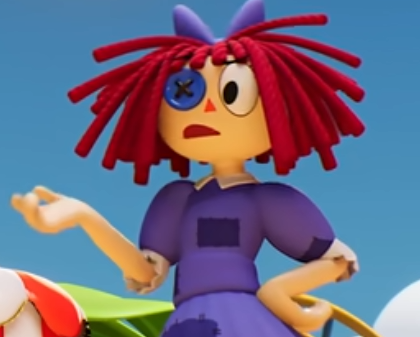
And I hope you understand why I bring up Bump In the Night, here, but I think it’s obvious that Digital Circus drew inspiration from it, at least in some of its visual style. Here’s Ragatha:
And here’s Molly:
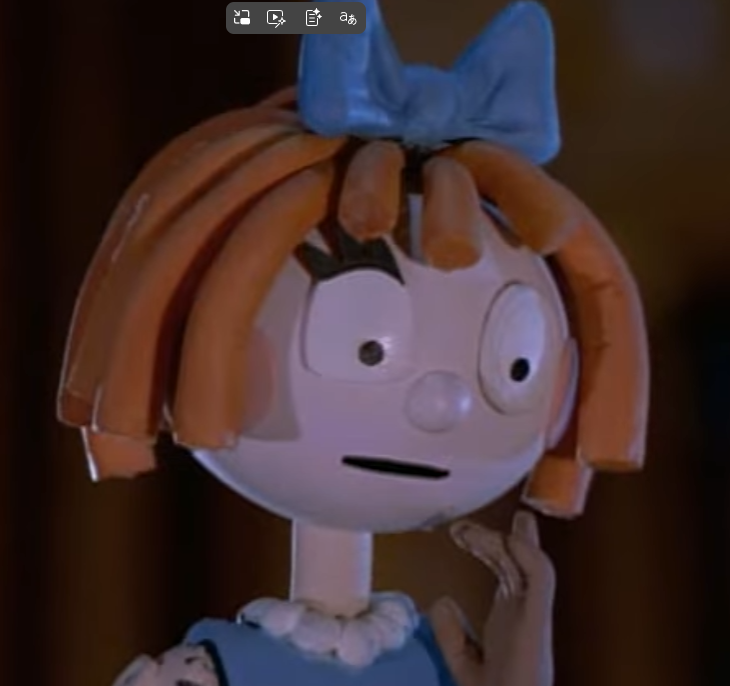
Of course, both characters were inspired by Raggedy Ann, but you can see that both characters are going for a sort of beaten-up, abused toy thing. In fact, I think Molly is supposed to have a button eye, but I guess they put an eyeball over it for whatever aesthetic reason.
And I think when you’re looking at both of these shows, if you imagine Amazing Digital Circus is inspired by Bump in the Night, it might make a lot more sense why Gooseworx has continually insisted that the intent of the show has not been about psychological horror or anything. Bump in the Night may have been set in the night, and was about monsters, which always gave it a haunted, gloomy atmosphere, but it wasn’t meant to chill the spine.
Regardless, at the end of the day, all I can remember from Bump in the Night is the visual aesthetic. I think that in twenty years, kids who watched Digital Circus are going to feel the same way. There’s a distinct aesthetic, a memorable look to Digital Circus, but nobody is going to remember what most of the characters did or said, or what their personalities were supposed to be like, unless those kids were also involved in the kinds of online fandoms that will convince people Nebuchadnezzar is the Bible’s protagonist and that he was totally sleeping with Paul.
How to Begin?
So why aren’t they memorable? Where is it going wrong? Early on, I remember seeing a Twitter post (or an X-ticle or whatever, I don’t care) where Gooseworx asked what the best way was for a person to improve on creative writing. Well, I brought up all that monopoly stuff because, earlier, before everything got dominated and heavily enshittified by cartels, you could write fanfiction and it was surprisingly easy to get at least a few dozen readers who might give you feedback. If you kept on writing, you kept getting feedback, and as you got better at it, you got more readers and more feedback.
I used to do a lot of recreational writing just for my own fun back in that era of the internet. I’d write short stories for little communities, sometimes for even as few as two or three people if that’s all the audience that was there. Often, the point was just to see if I could write something that people would notice enough to say something about. I wrote fanfiction about Warhammer 40k, about My Little Pony, and even wrote a few esoteric game guides for how to play games comedically worse. Aside from writing, I did a lot of roleplaying, but with the emphasis being on the improv and actual character roles, rather than on combat – though if you ever want to go the roleplay route, you need to curate your player group and also your system very carefully, because non-story roleplayers will fight you, and systems like D&D will also fight you.
But a lot of this is not as available as it used to be. You could probably join a Discord server and post short stories to entertain people in those communities, but Youtube has created an online ecosystem where your attention is very much a commodity, and everyone is constantly being asked to pay attention to everything. It’s rarely now presented as things people are making in the hopes to entertain humans, but rather as things people are making in the hopes of tapping into some kind of algorithmic blunder. Too often, people are making things for machines which then might attract humans as a byproduct, and because products for the machine tend to not really be tailored to humans, having walls of text shoved in your face doesn’t automatically make you think, “Wow, a story just for me and this community, how cool.”
Instead, you think, this person is trying to be found. They’re trying to virally promote themselves. Odds are this isn’t going anywhere, and there’s no reason to care. In a world where the machine gets first dibs on everything, everything winds up feeling artificial and processed. Even if you make things with the intent of being authentic, it’s hard to convince people of that. It’s hard to get them to give new things a chance. And on top of that, nobody wants to sit and read this horrible, low-quality garbage you’ve written. Why would they bother when the lowest quality productions you can imagine are being served fresh from algorithmic Hell millions of times each day? We are buried in trash, there is no escape, nobody is excited to have even more of it piled on them, even by their friends!
So simply diving right in to get feedback is a lot harder than it used to be. Getting brutally honest feedback is also no cakewalk. Years ago, 4chan was a decent place to share your work if you really wanted to be harangued, because within all the lambasting would be a few sprinkles of constructive criticism. Now, however, it’s a just a cesspit of political agitators, most of them probably bots, and you’ll be unlikely to find someone willing to sit down and ask you to improve. Elsewhere, accounts are tied to individuals, and “negativity” generally gets “downvoted” or otherwise purged or dogpiled.
I’m not even sure that humans are always necessarily the ones doing the dogpiling anymore. If you were to criticize some film while it’s in its promotion phase, you might get completely obliterated because companies are actively looking for those kinds of posts and using bot networks to smother them. Either way, people get used to the feeling that criticism will get you destroyed, banned, downvoted, or whatever, so most often, you get met with the void. The terrible, endless silence of the entire online world ignoring you at once.
The worst part is, if you can find a place that will give you feedback, the thoughts of one person are just part of a complicated jigsaw puzzle. Yes, what others think of your work does matter, but you can’t become completely divorced from yourself, so you need to take that feedback and integrate it into your own process. There’s no formula. It requires thinking, digesting, and trying again, over and over. Improvement requires iteration, and the gauntlet will scrape you pretty bare.
At the end of all this, I’m not saying it can’t be done. I know people who still do things creatively without having the luck of stumbling into algorithmic success. I don’t know happy people who fit that description, though. That is, I know people who love creative work and would do anything for it, but I don’t know anyone who’s positive about today’s ecosystems, or who has any good advice to find a better ecosystem. Believe me, I wish I did. I guess what I’m saying is that to start with, you really have to be prepared to get skinned raw.
There are many things that are successful that aren’t necessarily very good. You can’t copy those things and succeed likewise. There are many things that are quite good that fall between the cracks. You should copy them, even if they failed. If something is good, if it resonates with you and you know you really love it, then you can learn from it, and you’ll have a lot more fun emulating it.
Circling back to the comparison of Digital Circus and Bump in the Night, it feels that Digital Circus has lovingly emulated some of the things that made Bump in the Night visually interesting. It’s not close enough I can pull them up one to one because Digital Circus is its own distinct project with years of experience in creating visual artwork, but it might be a good example of loving qualities in something that wasn’t very successful and using that to make something new. Bump in the Night didn’t have amazing writing, but I think if you pitched it to people as an upcoming Youtube series, people would take an interest in it just because it looks different and distinct at a glance.
Cut Yourself With Both Edges
Now, we all learn to write, but what we’re taught in school is expository writing. Basically, just how to write facts that an authority figure has already presented to you as correct information, and often you’re encouraged to write this in a way so as to avoid scrutiny. In fact, one of the reasons I started writing fanfiction for My Little Pony was because I was in college at the time, and my best grades always came from writing purple prose that was so boring nobody would follow it. I was getting tired of writing multi-page essays that I intended the reader to ignore, so I began contributing to wiki pages, 4chan, or wherever I could flex a creative muscle.
If you were an A+ English student, you’re probably in dire straits as far as creative writing goes. You may have had a good teacher, but if not, an A+ meant you really didn’t have any thoughts of your own, and you were able to succinctly summarize your teacher’s opinions in a way that didn’t lose their attention, without flourish. In my experience, writing an impenetrable fog of meandering bullshit was always good for a B, but honestly it’s not good practice to be writing like that either. We’re taught in school to explain information, but what if you want to write stories and characters? What if you want to explore a theme, or some kind of complex moral framework?
Well, the first thing you have to realize is that you’re wrong. And that’s why you really won’t learn creative writing from school – because it’s wrong. Whatever you write is wrong. Nobody has all the answers, whatever you write isn’t going to be objectively correct, and it will always be poisoned by your own biases. You tell a creative world what it is, and if you think something is a certain way, that’s how that world will be regardless of if it makes sense to anyone else. If you’re particularly incorrigible, sometimes being wrong about everything is the whole point!
Once upon a time, I drunkenly lied to a Denny’s waitress about the plot of the Hunger Games, a movie I hadn’t seen. The waitress could tell I didn’t know what I was talking about, but she sat down across from me and kept asking what happened next, so I kept inventing more ridiculous lies in the weave of a narrative.
There are wrong ways to tell a creative story, but nobody can tell you exactly how to do it well, yet I think a key thing to understand if you want to hold a Denny waitress’s attention is to realize that everything that seems good about a person is also their worst quality. Holding to that, drunk or not, you can just about tell the story blind. The tale of the Drunken Hunger Games focused entirely on Peta because I knew that he baked cakes in the original story, and this was used as an excuse for him to know about camouflage somehow. The story I chose was of a character with almost supernatural cake-baking ability who wanted to use cakes to get out of almost every problem.
What got the waitress hooked was that I started with a few implausible but funny ways for Peta to have succeeded in a death match by baking cakes. He creates an oven out of mud, mixes ragweed grains with water to make flour. Now you may be wondering – what does he use as a binding agent? You see, it’s the springtime, so of course, our hero climbs the trees and gathers bird eggs. Using all of his baker skill, he creates a man-sized cake in the middle of the woods. When an enemy finds the cake, they think “What luck!”
But then, as they go to cut a slice, Peta leaps out of the cake and hits the other combatant with a rock! Everyone doubted Peta, but no more. And this goes on, but there’s a twist. Soon we find that baking a cake simply can’t save the day, but Peta wants to do it anyway because it’s always worked for him in the past, and he doesn’t want to get away from a good strategy. This leads to him fighting with Katniss about the best way to move forward, with her thinking they should use archery and him thinking they should use cakes. Katniss turns out to be correct, but Peta’s faith in himself winds up shaken. Now he doesn’t know if he can succeed, because if cakes can fail here, then they’ll inevitably fail him again and he’s sure to die. But Katniss is there for him, and between the two of them – her with her knowledge of an actual weapon, and him with his knowledge of cake – they defeat all of their enemies. I think I ended the story with the bad guys who run the hunger games thinking they’ve won, but there’s a cake at their celebration party, and Katniss leaps out of it to shoot the evil king or whoever he was.
I hope you kind of get a sense for the system at play here. Basically, you have a character and they get through life in some way. They have some kind of coping mechanism, and this usually works for them. However, the story involves a change of circumstance to their life, and now the traits they used to rely on are inefficient. Something has to change, and that’s kind of the point of the story. The character doesn’t have to become a new person, but they can form new personal bonds, or learn new things, or may even get so good at baking cake that it kills Frieza, or whatever. It’s worth noting that the story doesn’t have to come out and say the strength of the hero is wrong, so much as it’s important for you as a writer to understand that this big strength is also the character’s core flaw.
A good example from popular fiction would be Ned Stark in game of thrones. He’s presented as a very straightforward and honorable individual who will tell you exactly what he thinks and what he wants to do. He’ll treat you as an equal and expects you to do the same. Almost every character in the book who knows him will describe this as his personality, and describe it as what’s greatest about him, and yet at the same time they all agree it’s exactly why he died. Stark enters the political stage at a time of scheming and upheaval, where the courtesans are poisoning each other and the future of the throne is up in the air. Being up front about your intentions simply doesn’t work in this place and time, and while it made him a well-respected general and leader within his own camps, it becomes his downfall when surrounded by duplicitous enemies who don’t think like he does.
Everyone works this way, leaning towards a practiced coping strategy. Understanding this will let you understand your characters and what the next conflict is almost certain to be. I once read someone’s outline for a story they intended to make, and they described each of their characters with words like “brave, kind, gentle, funny” and so on. It read like the Boy Scout oath: scouts are Trustworthy, Loyal, Helpful, Friendly, Courteous, Kind, Obedient, Cheerful, Thrifty, Brave, Clean, and Reverent. That was the first thing about their outline that I attacked.
The difference between thrift and being a miser is connotation. Someone who is extremely careful to spend money is naturally going to run into conflicts where they don’t know if they’re withholding their money too much. If that’s the defining trait of a character, it will be their defining weakness. The difference between bravery and foolhardiness is going to involve whether or not the character dies from that bravery. A courteous or helpful person can be taken advantage of. Being too trustworthy makes a person too predictable. Loyalty can be betrayed! Being too cheerful can make you blind to horrible realities!
The point here isn’t to be cynical, but to recognize that if you’re going to say a character in a story is “cheerful” as a leading trait, you mean “to a fault”, because it’s a notable thing that has to be involved in the story somehow. Even if it’s not going to be a main source of conflict all the time, it does inform us how the character is going to try to solve problems, and that informs us of what kinds of problems are going to be difficult for the character to overcome.
Sometimes the conflict can refute a character, such as when Ned Stark is destroyed by his own honor. Other times, it’s just the path the character continues down on. Goku loves to fight and loves challenges, and this leads him into situations where he’s fighting people who are too strong for him, but he just doubles down on his love of fighting and keeps doing it until he wins. If Ned Stark had managed to survive and take control of King’s Landing, and everyone insisted he lead because they admired his honorable, forthright nature, then that’s a story that cherishes the trait that doesn’t highlight Ned’s honor as a weakness – but do be aware that the honor is still what likely set him on the conflict!
Confidence is arrogance. To be trusting is to be gullible. A man who wants to constantly demonstrate his own strength will eventually find himself weaker than someone or something. The ways we all cope with life are strategies that work for us most of the time, and they’re the things we practice most, so that we become quite good at living with and using those traits. Hence, those traits are the first thing we fall back on whenever we’re faced with challenges. Ned’s a well-written character because when faced with Cersei’s betrayals, the first thing he does is fall back on an honorable coping mechanism and informs her that he’s going to reveal her actions. It gets called stupid in hindsight because her reaction to use corruption to leverage an advantage seems obvious, but if the corruption weren’t already in place, then the guards wouldn’t have cooperated with Cersei, and Ned would be praised for being so even-handed. If Ned hadn’t tried to do the honorable thing, then he just wouldn’t be Ned.
(A bit of a note, here: good character writing rarely means having characters act with the same knowledge the audience has. Ned doesn’t know Cersei has full control of the guards. He trusts Petyr Baelish to get the guards on his own side, and even that strains him because Petyr suggests confirming their reliability with bribery. Sometimes, when talking about writing, I’ll see people defending especially poorly-written material by insisting it’s “logical”, given a character used practical information to inform their choices. Seldom will this lead to a more interesting nor a better-defined personality, however, because a character’s choices should have to be influenced by their emotions as well.)
Bad qualities can also be good. If you look at something a little closer hewn to reality, “The Romance of the Three Kingdoms” describes Cao Cao as a crafty politician who betrays the Han to serve his own ends. He tries to depict himself as a servant of the empire, but the fact is that he’s placed the Emperor under house arrest and is using him to sign off on whatever Cao Cao is doing. Yet though Cao Cao is depicted as wrong for this, his actions running counter to what a servant of his empire should be, you’ll find fans of the story still rooting for Cao Cao because it’s a conniving time full of scheming people, military conflict, and broken alliances. Cao Cao’s traits are “bad”, and yet he rises to the occasion and asserts himself above his rivals. He is scheming and manipulative, yet in this context is also clever and resourceful on the other side of the same token. An evil man using wicked traits to do something the audience might view as good – such as stabilizing a nation – is the essence of an anti-hero.
You’ll also find Cao Cao rewarding a man with a box of silver for killing his wife and feeding her to Lui Bei, but there’s some peculiarities in the story owing to culture and time. The Romance is a fiction, meaning it makes quite a few things up or gets things wrong, and as I said before, a story is, by its nature, false. All lies, colored by the morality and opinions of the person who writes it. Yet, they’re lies based on truth.
A simpler narrative character trait could be seen from Fluttershy from the My Little Pony cartoon. I bring this up because it’s something people used to argue with me about to defend the show, but early on, her core strength and weakness was that she’s “shy”. More accurately, she was conflict avoidant. If you think about it logically, Fluttershy’s personal coping method makes sense, because hiding and avoiding conflict probably successfully prevented her from being in many conflicts until it suddenly, and without her input, became her job to be in conflict all the time.
To create a sense of “character growth”, the show bashed on her for being “too shy” all the time, and eventually she “became less shy”, which mainly meant she spoke up to dump exposition on occasion. The show never really explored the advantages of conflict avoidance or passivity. It didn’t get into why people actually become that way, or how it’s something that gets practice and refinement just like all personality traits. It insisted her personality was bad, that she needed to reform out of it, but then never really gave her anything else to be or anything else to practice.
It bothered me, because though you might not believe it, I’ve been the quiet guy in a lot of scenarios. A lot of times people don’t mind it so long as you’re paying attention and helping out, and it gives you time to learn about people before you start interacting more directly. You can tell what kinds of traits people have and then tailor your interactions with them a little better based on your observations. There’s nothing wrong with that strategy, especially if you practice it and feel comfortable with it. It’s not necessarily better or worse than being the first person to make an impression – all that matters is if it’s fitting for the time and place you’re in, and if you’re good at it.
Why You’ll Forget
So where does Digital Circus go wrong? The characters just don’t have strong personalities. They don’t come across as being particularly good or well-practiced at any of their personality traits. Pomni is supposed to be… what? Nervous? If so, she certainly doesn’t fall back on that very often. A nervous person is usually solving problems by minimizing risk, so you’d expect that to be the strategy they lead with. And I think the emphasis here is that a strong personality leads. A strong personality is strong because it’s practiced frequently and the person who has those traits knows how to use them to get through a situation.
What we see in Digital Circus are a lot of personalities that are very passive, that are followers at best. Nobody leads, nobody is especially practiced at any specific traits. Everyone feels very awkward, and like they’re not sure who’s in charge, or where they should be – and before anyone leaps in to say that the show is applying hyperdimensional psychology and certainly that’s the whole point – I think it’s a lot more likely that the show just doesn’t have very skillful character writing. If the point were that everyone is a follower and doesn’t know what to do, in those situations everyone is usually paralyzed by any kind of dilemma or decision, and there’s no leaders, so instead they’ll try to create a group consensus before anything happens.
You could make a show about people who are followers as their strongest, core personality. That’s also a kind of coping mechanism. We’ve all probably met at least one extremely talented “follower” before, and it’s that person who’s always there for the group, yet they will leap off that bridge if their friends are doing it. A room full of personalities that do that would be… interesting, in a way that might want to make the viewers kill themselves out of frustration, but I think you could do it. We rarely see that kind of personality depicted as the hero, but I can imagine it working well in a character comedy. A good example of that would be Michael from “The Office”, where the comedy is that he’s a pure follower type who got promoted to boss, and he cannot lead.
No, the problem with Digital Circus is that the writing is very expository and the traits of the characters are fairly unclear. You have some vague understanding of what each character is supposed to be like, but nothing shines through all that well. The conflicts simply happen around everyone, and then the conflicts resolve themselves without real input from anyone. We have a character who regains their sanity in the darkness, but it doesn’t seem to matter if they’re crazy or sane because there’s nothing to solve and nothing going on that requires the character to be around. I’ve heard it said that the point of the show is to explore the idea you could be comfortable with mundanity, or with being in a comfortable yet listless rut, but I feel like that’s a moral you come to after being beaten down, like the ending to 1984, a story where the protagonist loses and gives up in futility.
The stories we remember are the ones that resonate with us emotionally, and when characters have many strong feelings and strong personality traits, we empathize with them and share their feelings. In twenty years, people won’t be able to remember exactly what happened in Digital Circus because no character has expressed any powerful emotions or strong traits, except for maybe Pomni’s anxiety attacks in the beginning. Her having anxiety attacks made people think she’d probably have strong feelings, and strong reactions going forward, but that didn’t materialize, and it didn’t materialize because the show’s author wasn’t sure what kind of personality Pomni had to begin with.
People aren’t going to remember exposition. Nobody is going to remember a scene where a character plainly explains how they feel, or merely explains what the conflict is. People remember the emotions, because feelings are how you make decisions and you’ll always remember how you felt for longer than you remember the facts or details. So at the end of the day, I think you can scoff, or insist that you don’t need strong traits or strong feelings, or even say that certain shows had feelings that are “strong enough”, but weak emotions lead to a feeling of “not much happening” for most audiences, and ultimately the real proof is going to be whether you remember much of it later.
Knowing how the character copes with their life – what makes them good – tells you what their biggest weakness is, and from that flows your story, sets up all your conflicts, and just makes the whole thing come out so much more naturally than trying to backfill all the space with exposition and soliloquy.